

A standard group movie night poll usually guarantees one thing: half the room ends up watching a film they have already seen. Spending thirty minutes debating candidate lists in a crowded group text kills the fun before the opening credits even roll. Friends vote tactically just to block bad picks, manual lists stall out, and decision fatigue takes over.
It doesn't have to be this exhausting. Discover how to run effective movie polls and eliminate decision fatigue for your next group watch party so you can settle on a film within five minutes of gathering. We will break down how to automate candidate discovery based on collective taste, sidestep popularity contests, and ensure your final pick is fresh for every single viewer.
Key Takeaways
- Manual nomination lists and simple majority votes create decision fatigue and settle on bland compromise picks.
- Structure a better group movie night poll by capping choices at four genres and verifying streaming availability in advance.
- Dynamic title sorting eliminates repetitive viewing by pinpointing fresh films that nobody in your circle has watched yet.
- Shared digital rooms let everyone vote quickly on their own device to lock in a selection within five minutes.
Why Traditional Movie Night Polls Fail to Deliver Consensus
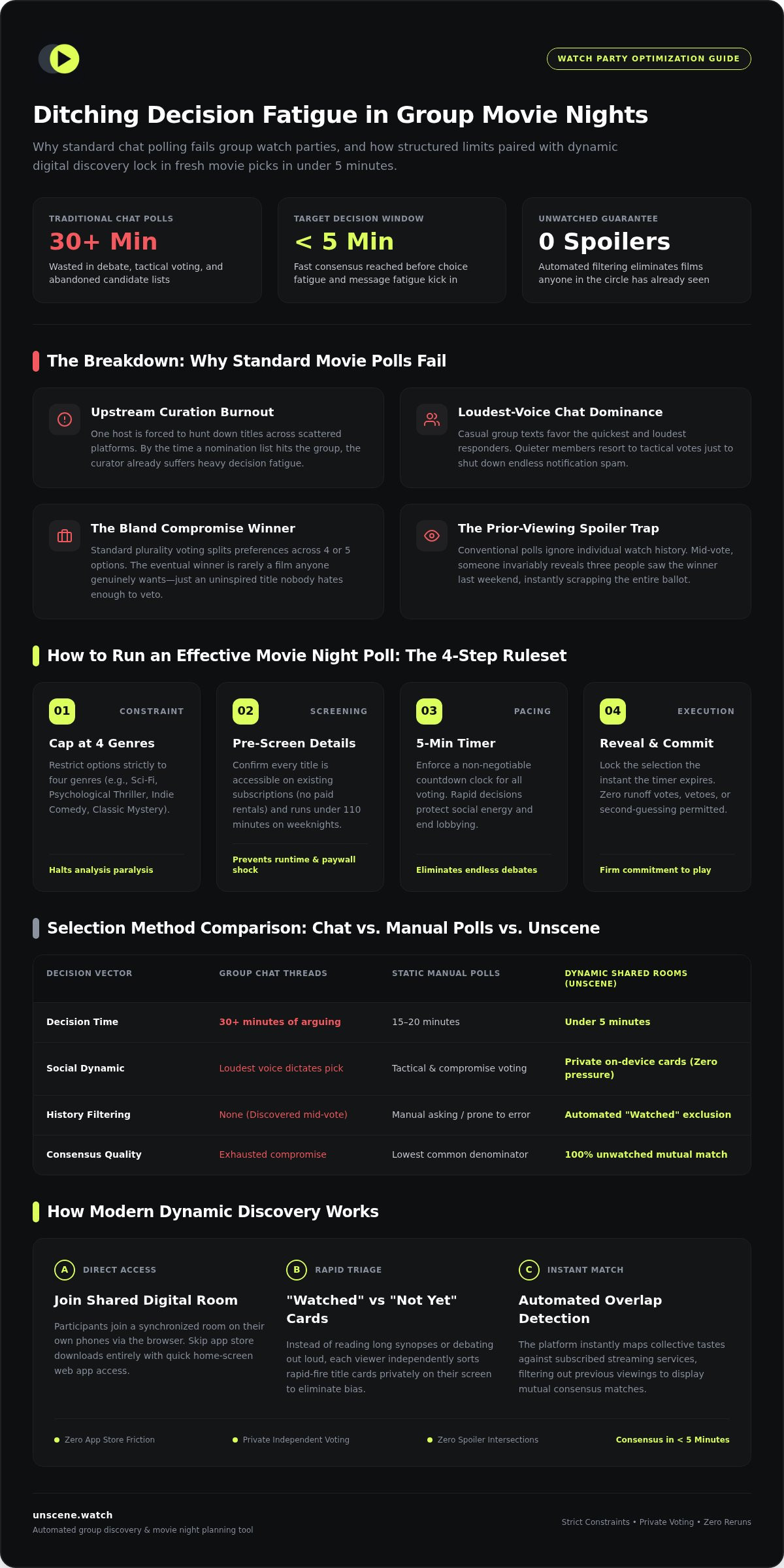
Most watch parties derail before anyone hits play. Running a manual group movie night poll usually requires one person to hunt down nominations across multiple streaming services. This upstream curation triggers severe choice fatigue. By the time a list reaches the group, everyone feels drained.
Standard plurality voting makes things worse. When participants pick just one favorite from a static list, votes scatter across four or five titles. The winner is rarely a film anyone genuinely wants to see. Instead, it becomes an uninspired compromise pick that nobody hates enough to veto. Worse yet, conventional polls ignore prior viewing history. Halfway through setting up the vote, someone invariably speaks up: three people watched the winning candidate last weekend. The spoiler problem forces the host to scrap the ballot and restart from scratch.
The Hidden Traps of Group Chat Voting
Casual group chat threads amplify classic flaws in group decision-making. The loudest, quickest responders dominate the nomination pool, drowning out quieter friends. This dynamic quickly leads to tactical voting; members stop voting for their true preferences and back safe, mediocre titles just to end endless message notifications. Switching to a dedicated movie night planning tool eliminates these social pressures by collecting input independently rather than through noisy group texts.
How to Run an Effective Group Movie Night Poll in 4 Steps
Running a successful vote comes down to tight constraints. If you throw ten random choices into a chat, discussion grinds to a halt. Follow a disciplined four-step structure to launch your next group movie night poll cleanly:
- Cap genres at four: Restrict options to four distinct genres, such as sci-fi, psychological thriller, indie comedy, and classic mystery. Variety prevents genre burnout while stopping analysis paralysis.
- Pre-screen streaming availability: Confirm every title exists on platforms your group already accesses. Never list a film that requires an unexpected paid rental.
- Enforce a hard five-minute window: Set a strict timer. Fast voting maintains social energy and prevents endless lobbying.
- Reveal and commit: Lock the selection the moment the timer rings. No run-off debates or second guesses allowed.
Filtering Shortlists by Real Member Availability
A polished ballot fails instantly if the winning movie is behind a paywall or runs three hours on a work night. Always check runtime against your schedule; aim under 110 minutes for casual weeknight gatherings. Most crucially, audit watch history upfront. Settle disputes early, or use an interactive web tool to plan a movie night that matches unwatched titles across your group automatically.
Modern Group Discovery: Upgrading Beyond Static Polls
Static voting lists simply cannot keep up with diverse tastes. When you rely solely on a standard group movie night poll, you force members to choose among fixed nominees curated by just one person. Dynamic preference matching flips this model completely. Instead of debating pre-selected titles, members join a shared digital space where automated sorting evaluates everyone's tastes simultaneously.
Modern platforms streamline this process through rapid-fire title cards. Rather than reading endless synopses, participants quickly sort suggestions into "Watched" or "Not yet" on their own screens. The system compares responses instantly, filtering out previously seen films and calculating true group overlap across streaming services and personal libraries. This automated matching surfaces fresh, unwatched titles in seconds, cutting out manual compilation entirely.
Streamlining Watch Decisions with Dedicated Group Rooms
Shared rooms protect honest opinions. Group chat voting invites peer pressure; vocal members often influence quieter friends. In a synchronized room, everyone casts individual votes privately on their phones. When nobody knows who voted for what, tactical choices disappear. Rapid title cards make screening effortless, pinpointing the perfect title without awkward living room debates. For recurring gatherings, you can easily organize a movie club online to keep regular watchlists organized and track group preferences week after week.
Ditch the Group Chat Debates for Good
Planning what to watch shouldn't drain your evening before the opening scene begins. A standard group movie night poll often locks your circle into awkward debates and stale compromises. By keeping nominee lists tight, screening runtimes in advance, and moving toward dynamic discovery tools, you can choose a film effortlessly every time.
Unscene removes the friction of manual curation. Multi-user shared rooms give each person private voting cards on their phone, completely eliminating tactical voting. The platform instantly filters out films anyone has already watched, revealing mutual matches everyone can enjoy. You skip app store downloads entirely with quick home-screen web app access. Find an unwatched movie your whole group loves on Unscene and press play within minutes.
Frequently Asked Questions
How do you create a movie night poll without bias?
Keep nominations anonymous and collect votes privately on individual devices rather than through open group chats. When using a group movie night poll, avoid revealing running totals until the voting window closes. This prevents dominant personalities from steering the room and stops tactical voting before it starts.
What is the best format for group movie voting?
Ranked choice ballots and rapid-fire title cards perform significantly better than standard single-choice polls. Instead of picking one title from a rigid list, participants swipe or sort options individually. This approach calculates true overlap and identifies movies that satisfy the entire room rather than just a vocal minority.
How many options should be on a movie poll?
Limit your list to three or four distinct titles across varied genres. Providing too many options causes decision fatigue and stalls your watch party. A tight shortlist speeds up decision-making and ensures everyone can review the candidates in just two or three minutes.
How do you pick a movie everyone in the room has not seen?
Screen watch history before opening the ballot, or use discovery tools with built-in unwatched matching. Platforms like Unscene let each participant mark rapid-fire title cards as "Watched" or "Not yet," automatically surfacing titles that are fresh for every person in your group movie night poll.


