

One in five viewers abandons their streaming session entirely because they are overwhelmed by choice. Research shows the average person spends over ten minutes actively browsing before they even hit play. If you are the movie night coordinator, this pressure is personal. You want a great night. Instead, you get arguments over genres and endless scrolling through 2.7 million titles. It feels like work.
It doesn't have to be this way. You can master group movie planning and eliminate choice fatigue with a few smart shifts. This guide provides a functional, streamlined path to reaching a fast consensus. We agree that social time should be about the experience, not the administration. You will learn how to find movies no one has seen yet while keeping the atmosphere relaxed. Follow these five essential steps to create a stress-free social experience every time you press play.
Key Takeaways
- Learn how to manage group psychology to avoid the social friction of choosing a film.
- Master the role of a movie night coordinator to ensure every gathering feels intentional and organized.
- Follow a five-step framework to audit your setup and verify streaming access before guests arrive.
- Compare manual voting against automated matching to find the fastest way to reach a group consensus.
- Use personalized discovery quizzes to uncover hidden gems that no one in your circle has watched yet.
What Is a Movie Night Coordinator?
Search for this job title on a recruitment site and you might find listings for professional event planners with years of experience. In reality, the movie night coordinator is usually the friend who owns the most comfortable couch or the biggest TV. You are the social glue of the group. While the title isn't official, the responsibility is real. You are the person who initiates the plan, manages the group chat, and ultimately hits the play button.
The informal nature of this role doesn't make it easy. Your core goal is to maximize group satisfaction while minimizing friction. This requires a delicate balance between being a leader and a listener. You must navigate the choice overload phenomenon, where having 2.7 million titles available across streaming services actually makes it harder for your group to reach a decision. Without a clear coordinator, most movie nights end in 45 minutes of aimless scrolling.
The Social Responsibility of the Coordinator
Every social circle has a designated "movie person." You likely hold this position because you have a broad knowledge of genres or a knack for logistics. It is your job to set the vibe for the evening. This involves more than just picking a high-rated film. You have to balance different tastes, sensitivity levels, and attention spans. If a friend hates jump-scares or someone else has already seen every blockbuster, you are the one who filters those options out.
There is often an emotional weight attached to a bad pick. When the movie is a dud, the movie night coordinator often feels the blame. This pressure causes decision paralysis. To succeed, you must move away from being the person who "picks" and toward being the person who "facilitates." Your job is to create a system where the group feels involved in the choice without the stress of the search.
From Manual Planning to Digital Facilitation
Traditional coordination is a heavy lift. It usually involves endless texting, sending trailer links that no one watches, and running democratic polls that end in a tie. This manual approach is the primary cause of choice fatigue. It turns a fun social gathering into an administrative chore. Modern coordination requires a more streamlined strategy. Use digital tools to handle the heavy lifting for you.
- Sync group streaming availability before anyone arrives.
- Use a "What to Watch Quiz" to narrow down the mood of the room.
- Identify content that no one in the group has seen yet.
- Set a firm "stop time" for the selection process.
Digital facilitation reduces your workload. Instead of debating for an hour, you can use a movie club organizer or discovery app to present two or three vetted options. This shifts the focus back to the social experience. You spend less time acting as a negotiator and more time enjoying the film with your friends.
The Science of Choice Fatigue in Groups
Selection is often the most exhausting part of any social gathering. With over 2.7 million unique titles available across streaming services, the Paradox of Choice is a constant hurdle. Groups struggle more than individuals because every member brings a different set of preferences and thresholds for satisfaction. This often leads to the "scroll-and-fail" cycle. The group spends more time looking at thumbnails than actually watching a story. As the movie night coordinator, you are the only one who can break this cycle before the evening ends in frustration.
Research indicates that the average viewer spends 10.5 minutes browsing before making a choice. In a group setting, this time usually doubles as participants debate genres and actors. Eventually, 20% of viewers abandon the session entirely because they are overwhelmed. Your role is to act as the choice architect. By narrowing down the options before the group meets, you prevent the mental exhaustion that comes from too many possibilities.
Why More Options Lead to Less Satisfaction
Cognitive load increases with every new row of recommendations. When a group faces thousands of titles, the brain begins to shut down. People start to feel the effects of decision fatigue, which include mental exhaustion and an inability to weigh options logically. This leads to "just picking anything" simply to end the search. In a group, Fear of Missing Out (FOMO) makes the situation worse. No one wants to be responsible for a boring choice, so everyone hesitates to commit. This collective indecision kills the momentum of the night.
Identifying the "Seen It" Problem
Nothing ruins a recommendation faster than one person saying they have already seen the film. This happens because most social circles don't have a way to track their collective watch history. To be an effective movie night coordinator, you need transparency in what your friends are watching. Tracking group watchlists manually is difficult and time-consuming. Using a digital tool to identify content that is fresh for everyone ensures that no one feels left out of the discovery process. You can plan a movie night that guarantees a new experience for the whole group by syncing preferences ahead of time. This eliminates the frustration of redundant suggestions and keeps the energy high.
Manual vs. Automated Movie Coordination
Choosing a movie shouldn't feel like a part-time job. Manual methods often consume the time you should spend actually watching the film. As a movie night coordinator, your stress levels peak when the group chat becomes a graveyard of ignored trailer links. Shifting to automated discovery tools changes the dynamic from negotiation to celebration. It moves the burden of choice from your shoulders to a streamlined system.
The success rate of your movie night depends on how you reach a decision. Manual voting often results in a "least disliked" option rather than a movie everyone is excited to see. Algorithmic matching offers a higher success rate because it processes variables like watch history and mood shifts instantly. By adopting strategies for better group decision-making, you can bypass individual biases and reach a consensus in minutes rather than hours.
The Old Way: Texting and Trailer Links
Group chats are notoriously inefficient for movie picks. You send a link; someone else sends a different one. Three people don't reply, and two people suggest movies the others have already seen. This manual coordination takes hours of intermittent focus. Majority-rule voting often leaves a vocal minority unhappy or bored. This friction kills the social vibe before it starts. The time cost is simply too high for a casual evening. You end up exhausted before the opening credits even roll.
The New Way: Shared Watchlists and Quizzes
Modern tools offer a better path. Preference matching finds the middle ground without the drama. Using a discovery app allows you to sync everyone’s tastes into a single dashboard. This approach identifies the overlap in what your friends want to watch. It is the most efficient way to act as a movie night coordinator without the manual labor of polling.
- Start a movie club organizer: Centralize your group’s "must-watch" list.
- Run a What to Watch Quiz: Use a tool like Unscene to narrow down genres based on the group's current energy.
- Utilize blind quizzes: These prevent peer pressure and ensure everyone’s taste is counted equally.
- Identify unseen content: Automatically filter out films that anyone in the group has already watched.
Unscene automates the discovery process by using personalized quizzes. It identifies movies no one in the group has seen, making your job effortless. Instead of acting as a negotiator, you become the facilitator of a fresh experience. This tech-savvy approach restores the fun to the planning process and ensures a stress-free social experience for everyone involved.
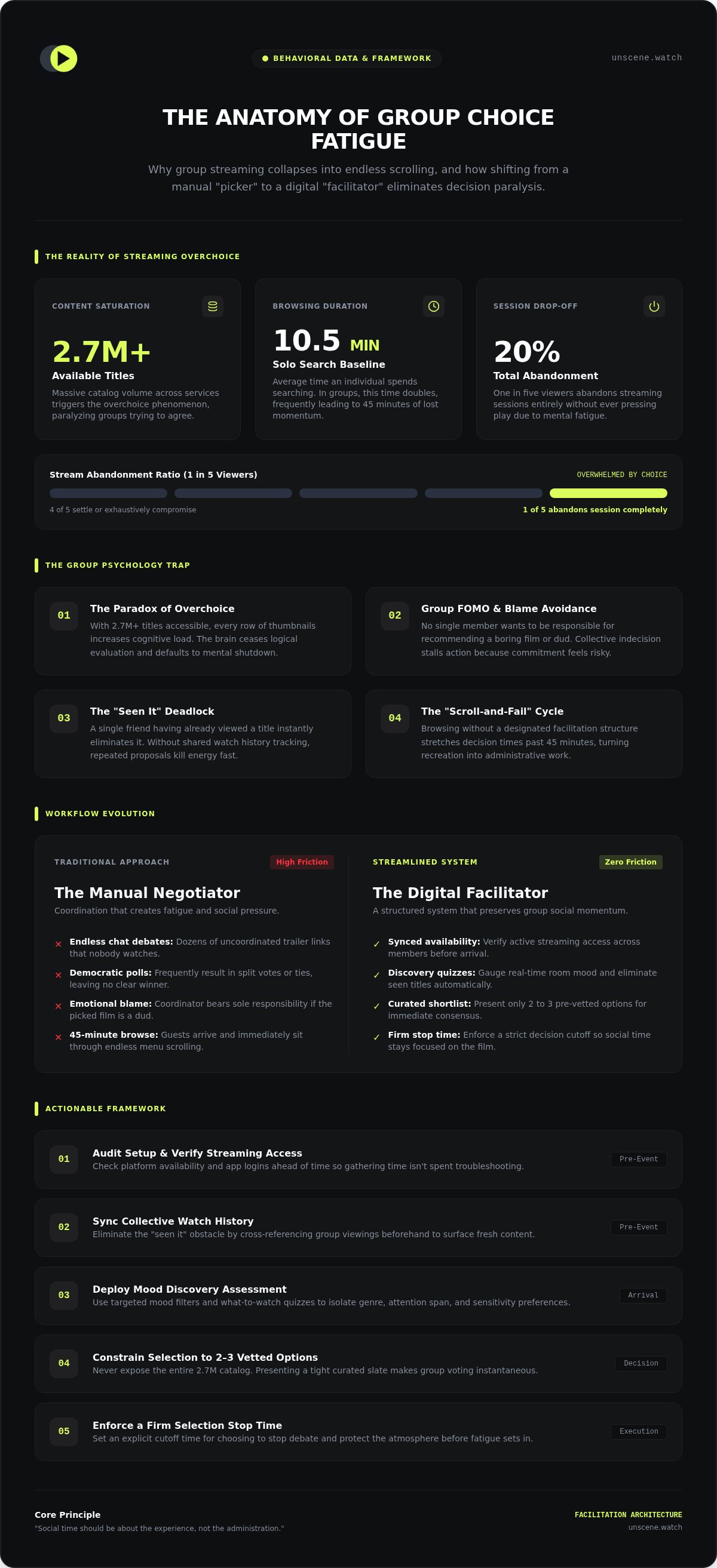
The 5-Step Movie Night Coordinator Checklist
Success requires a repeatable framework. Following a structured process ensures you spend your energy on the event rather than the decision. As a movie night coordinator, your goal is to move from "what should we watch" to "let's hit play" as quickly as possible. This checklist streamlines the logistics so you can focus on the social experience.
- Step 1: Sync streaming availability. Verify which platforms your group can access before you start browsing. Whether it is a Netflix Standard plan at $19.99/month or a Max Ultimate 4K subscription, knowing your toolkit prevents the frustration of finding a film you can't actually stream.
- Step 2: Use a discovery quiz. Narrow the mood before looking at titles. A quick quiz identifies if the group wants a high-stakes thriller or a lighthearted comedy. This bypasses the aimless scrolling through 2.7 million available titles.
- Step 3: Filter for fresh content. Identify movies no one in your circle has watched. This is the most critical step for a movie night coordinator. It eliminates the "seen it" interruption that kills group momentum.
- Step 4: Finalize the invite. Send a clear start time and the selected title to the group. Providing this information ahead of time reduces last-minute questions and helps guests arrive ready to watch.
- Step 5: Rate the experience. Facilitate a brief post-movie discussion. Gathering ratings helps your discovery tool learn group preferences, making the next planning session even faster.
Gathering Group Preferences Quickly
Collecting likes and dislikes shouldn't take all night. Use Unscene to capture preferences in minutes rather than hours of texting. This system handles friends with specific triggers or picky partners without the need for awkward public debates. It allows everyone to contribute their taste anonymously. Setting a strict 10-minute time limit for this decision phase keeps the night moving. It prevents the group from falling back into the cycle of indecision and ensures you actually finish the movie before midnight.
The Importance of Parental Controls
Family gatherings require extra care to keep the experience inclusive. When coordinating for groups with kids and teens, use family-friendly profiles to filter out inappropriate content automatically. This ensures every member has a voice in the choice while staying within age-appropriate boundaries. Digital tools allow you to apply these filters across multiple streaming services simultaneously. You don't have to pre-screen every scene manually. This tech-forward approach protects the group's enjoyment and maintains a safe viewing environment for everyone involved.
Ready to streamline your next gathering? Plan a movie night today and master the art of effortless coordination.
Simplify Your Next Movie Night with Unscene
Effective hosting requires the right tools. Unscene acts as your digital assistant, removing the friction of group decision-making. As a movie night coordinator, you no longer need to scroll through endless menus or manage messy group chats. The platform uses streamlined logic to move your group from indecision to immersion in minutes. It is a utility-first solution designed for modern social lives.
The "What to Watch Quiz" is the core of this experience. It solves the choice fatigue problem by narrowing millions of titles down to a few perfect matches. Instead of debating genres, your guests simply share their current mood. This process respects everyone's time and ensures the night stays focused on the film. It is the fastest way to reach a consensus without the usual arguments or ego depletion.
Personalized Discovery for Groups
Finding a film that everyone will love is difficult when tastes vary. Unscene identifies movies that align with the collective preference of the room. The "unseen by all" filter is a game-changer for any movie night coordinator. It cross-references watch histories to find fresh content that no one in the group has experienced yet. This eliminates the "seen it" interruption and keeps the discovery process exciting.
Creating watch parties takes only a few clicks. You can easily see "what are my friends watching" to get inspiration or avoid repeats. The platform facilitates shared discovery, making it feel like a collaborative activity rather than a top-down decision. This inclusivity ensures that even the quietest member of the group has their preferences represented in the final choice. It turns the search into a fast, shared win.
Start Your Digital Movie Club
Recurring nights need structure to survive. Use the movie club organizer features to manage your social calendar with ease. This tool allows you to compare preferences across your entire social circle over time. It tracks what worked and what didn't, helping the system learn your group's unique taste profile. This leads to better recommendations with every session. You spend less time planning and more time connecting.
The platform operates with a sense of modern efficiency. It values your time by automating the administrative side of hosting. You can stop acting as a negotiator and start enjoying the role of a curator. Take the stress out of your next gathering. Plan your next movie night with Unscene and experience a faster, more inclusive way to watch together.
Take Control of Your Next Gathering
Transitioning from manual scrolling to digital facilitation changes the energy of your social circle. You now have a repeatable framework to bypass decision paralysis and focus on the story. By using a structured checklist, you ensure technical readiness while respecting everyone's time. As a movie night coordinator, you have the power to transform a frustrating search into a shared highlight of the week.
Modern discovery tools handle the administrative heavy lifting for you. You can utilize personalized group quizzes to find consensus in minutes. These systems identify content fresh for the whole group, ending the "seen it" arguments that stall momentum. Integrated family-friendly filtering keeps the experience inclusive for all ages. It is time to reclaim your evening and prioritize the social experience over the search.
Stop the scroll and start watching with Unscene. Your group is ready for a better way to watch together. Start your next session with confidence.
Frequently Asked Questions
What is the role of a movie night coordinator?
The role of a movie night coordinator involves acting as the social facilitator for a group gathering. You handle the logistics of picking a film, syncing streaming availability, and setting the evening's vibe. Instead of just picking a movie, you create a system where everyone feels involved. This prevents decision paralysis and ensures the night stays focused on the experience rather than the administrative search.
How do you pick a movie with a picky partner?
Pick a movie with a picky partner by focusing on shared preferences rather than individual demands. Use a discovery quiz to narrow down genres and moods before looking at specific titles. This approach removes the pressure of making a personal suggestion that might get rejected. By identifying a middle ground through preference matching, you reach a consensus faster and reduce the friction that often comes with differing tastes.
What is the best app for planning a movie night with friends?
Unscene is the best platform for planning a movie night with friends because it streamlines the discovery process. It uses personalized quizzes to identify movies that align with everyone's current energy. The platform also tracks watch histories to ensure no one has seen the selected film yet. This utility-first approach saves time and removes the stress of acting as a manual movie night coordinator for a large group.
How do you avoid choice fatigue when picking a movie?
Avoid choice fatigue by narrowing your options to two or three vetted titles before the group meets. Research shows that viewers spend an average of 10.5 minutes browsing before making a selection. Setting a strict time limit for the decision phase prevents the group from falling into a scroll-and-fail cycle. Using an automated tool to pre-filter content based on group preferences is the most efficient way to maintain momentum.
Can I use Unscene for family movie nights with kids?
You can use Unscene for family movie nights with kids and teens. The platform features family-friendly profiles and parental controls that filter out inappropriate content automatically. This gives younger family members a voice in the selection process while ensuring the entertainment remains age-appropriate. It's a helpful tool for parents who want to find something new to watch together without manually pre-screening every scene.
How does a movie discovery quiz work for groups?
A movie discovery quiz works by collecting rapid feedback on genres, moods, and actors from every participant. The system then processes these variables to provide personalized recommendations that hit the middle ground for the entire group. It identifies content that no one in the circle has watched yet. This collaborative method removes individual biases and ensures the final choice reflects the collective interest of everyone in the room.
What are the best tools for organizing an online movie club?
The best tools for organizing an online movie club include a centralized movie club organizer and preference matching software. Unscene allows you to compare tastes across your whole social circle and track recurring viewing sessions. These tools manage the administrative side of a club, such as voting and scheduling, so you can focus on the discussion. Automated systems ensure that the club discovery process remains fresh and engaging for all members.
How do I find a movie that no one in my group has seen?
Finding a movie that no one in your group has seen requires syncing individual watch histories into a single dashboard. As a movie night coordinator, you can use Unscene's "unseen by all" filter to cross-reference what your friends have already watched. This eliminates the frustration of starting a film only for someone to say they've seen the ending. It's the most reliable way to ensure a fresh experience for everyone.
