

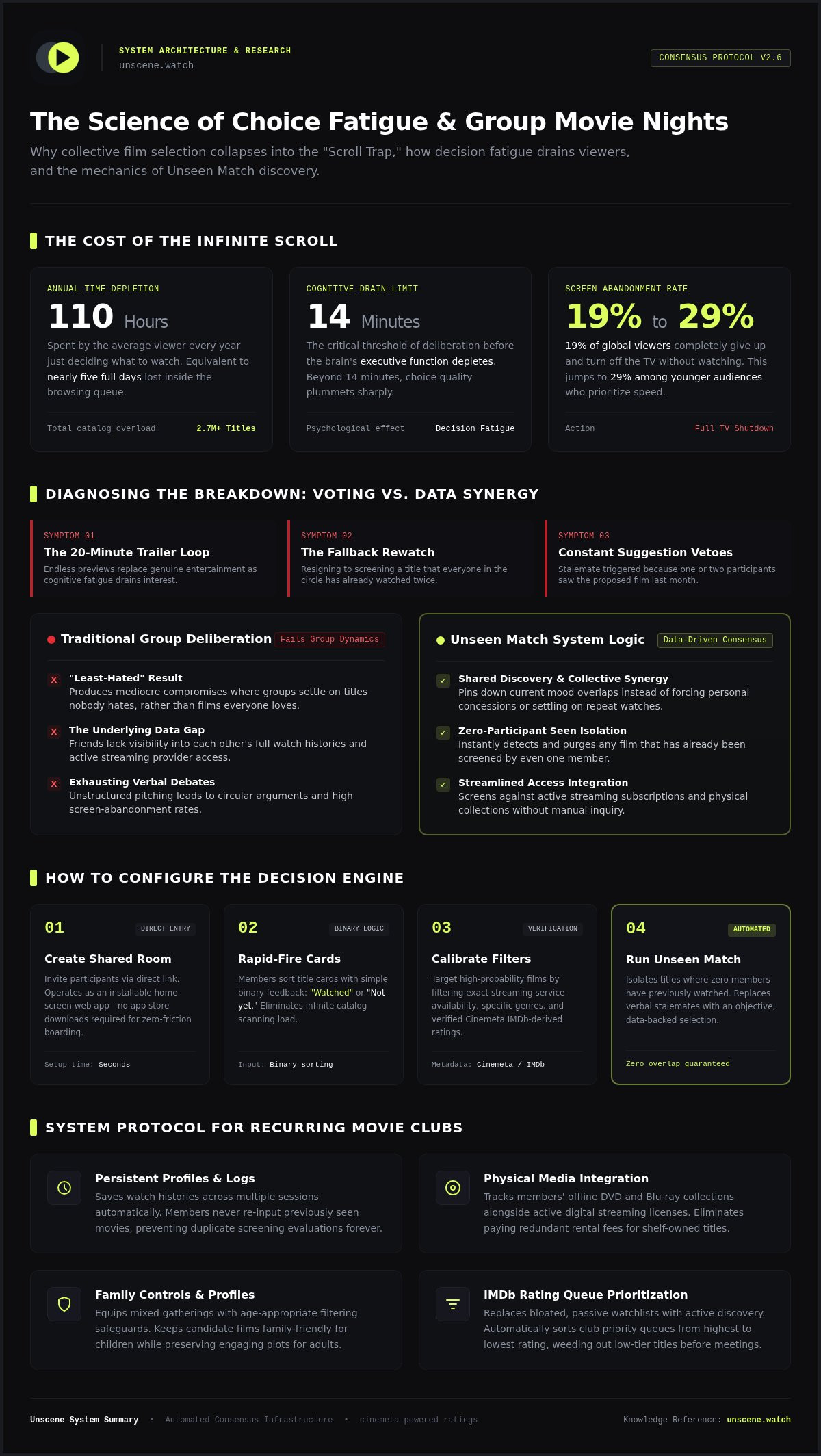
The average viewer spends 110 hours every year just deciding what to watch. That's nearly five full days lost to the scroll. Most group movie nights devolve into endless app-hopping and circular arguments. You want to relax, but the sheer volume of 2.7 million available titles makes it hard to choose. It's frustrating to pick a film only to realize half the group saw it last month.
Stop the search and start the show by using a dedicated movie night decision maker. Use this guide to set up a streamlined system that finds the perfect movie in minutes. Identify an "Unseen Match" where every member's preferences and watch histories overlap. Eliminate choice fatigue and build a reliable routine for every gathering.
Key Takeaways
- Understand why traditional group voting often leads to "least-hated" choices rather than movies everyone actually wants to watch.
- Configure a movie night decision maker to sync your group's watch history and preferences instantly through a shared digital room.
- Use rapid-fire title cards and "Unseen Match" logic to filter out movies that members of your group have already seen.
- Establish a recurring film club by appointing a coordinator and using a shared scheduler to manage busy calendars.
The Science of Choice Fatigue: Why Groups Struggle to Decide
Streaming services currently offer over 2.7 million titles. This abundance creates a cognitive drain known as choice fatigue. When groups spend 14 minutes or more browsing, the brain's executive function depletes. This aligns with the psychological concept of decision fatigue, where the quality of choices drops after too much deliberation. Instead of finding a hit, 19% of global viewers simply give up and turn off the TV. This rate jumps to 29% for younger audiences who value speed over endless scrolling.
Traditional voting usually fails. Most groups settle on a movie that nobody hates, rather than one everyone loves. This middle-ground approach leads to mediocre viewing experiences. You need a dedicated movie night planning tool to move past this stalemate. It shifts the focus from individual compromise to collective synergy. By focusing on shared discovery, you find titles that match everyone's current mood without the friction of a verbal debate.
Identifying the "Scroll Trap" in Your Friend Group
The "Scroll Trap" is easy to spot. Watch for these common symptoms:
- The 20-minute trailer loop.
- The fallback rewatch of a movie everyone has seen twice.
- Constant rejection of suggestions because someone has already seen it.
The real problem is a data gap. Groups rarely know each other's full watch histories or specific streaming access. A digital movie night decision maker bridges this gap by instantly identifying titles that remain unseen by every participant. This turns a messy group debate into a logical, data-driven selection process.
How to Configure a Group Movie Night Decision Maker
Start by creating a shared room. Invite your group using a direct link. You don't need app store downloads because the platform works as an installable home-screen web app. This low-friction setup ensures everyone joins the session in seconds.
Use rapid-fire title cards to sort through options quickly. Each member marks films as "Watched" or "Not yet." This binary choice removes the cognitive load of browsing infinite lists. Next, apply filters for specific streaming services, genres, or IMDb-derived ratings via Cinemeta. This narrows the field to high-quality titles you can actually access.
Launch the discovery engine to find an Unseen Match. This automated movie night decision maker isolates titles that zero participants have seen. It replaces verbal debate with a clear, data-driven winner. If you want a faster way to reach consensus, plan a movie night with your friends using these streamlined tools.
Syncing Preferences with Unseen-Match Discovery
The discovery algorithm identifies the exact intersection of your group's watch histories. Persistent user profiles save your progress automatically. You won't have to re-input seen titles for future gatherings. For mixed groups, enable family-friendly profiles and parental controls. This keeps results age-appropriate for kids while still finding movies that adults will enjoy. It's a functional utility designed to simplify complex group choices.
Optimizing Your Movie Night Scheduler for Recurring Events
Establishing a routine requires moving past ad-hoc planning. Shift from one-off decisions to a structured movie night coordinator role. This organizer manages the group's digital room. Use a dedicated scheduler to sync busy calendars for regular movie club meetings. This automates the scheduling process and locks in dates without endless group texts.
A reliable movie night decision maker maintains a saved watch history across multiple sessions. This persistent log prevents future overlaps. It ensures you never re-evaluate titles the group has already screened together. To maximize your options, integrate physical media tracking into your setup. Log your members' DVD and Blu-ray collections alongside streaming availability. This simple step expands your library. It stops the group from paying extra rental fees for movies someone already owns on a shelf.
Building Persistent Watchlists for Movie Clubs
Long-term engagement depends on how you capture ideas. Use a movie night planner app to store future candidates between scheduled events. This approach highlights the difference between active discovery and passive list management. Passive lists grow bloated and unmanageable over time. Active discovery relies on continuous filtering to keep the selection relevant.
Apply a quick sorting tip to streamline your queue. Use IMDb-derived ratings to organize your club's priority list from highest to lowest. This automated logic weeds out low-tier options before your next session begins. It keeps the group focused on premium content and guarantees a fast consensus every time you meet.
Take Control of Your Group Entertainment
Stop losing hours to the scroll trap. You've learned how choice fatigue drains your evening and why traditional voting often fails your friends. Shifting to a digital movie night decision maker transforms your gathering from a stressful debate into a streamlined social experience. By using persistent profiles and tracking physical media, you ensure every session is fresh and cost-effective.
Personalized group quizzes help you identify unseen matches instantly. You don't have to settle for the "least-hated" option anymore. It's time to reclaim your time and enjoy the films you actually want to see. Start your next movie night with unscene.watch and experience a faster, more inclusive way to watch together. Your perfectly matched movie night is only a few clicks away.
Frequently Asked Questions
How do I pick a movie with a picky partner or group?
Use a binary elimination system rather than open-ended questions. A digital movie night decision maker like Unscene removes the pressure of picking a single title. By swiping through "Watched" or "Not yet," you quickly isolate common interests. This data-driven approach avoids circular arguments. It helps you identify movies that neither person has seen but both would enjoy without the usual friction.
What is the best movie night decision maker for large groups?
The most effective movie night decision maker for large groups uses shared digital rooms. Unscene allows multiple users to join a session via a direct link from their mobile or desktop browsers. The algorithm then cross-references every member's watch history to find an "Unseen Match." This ensures the final selection is something new for everyone involved in the group, preventing wasted time.
Can I use a movie night scheduler for TV shows too?
Yes, you can use these discovery tools for both movies and TV series. The platform allows you to toggle between content types or search for both simultaneously. This is ideal for movie clubs that want to transition into watching a specific TV show together. Persistent profiles track your progress through seasons, making it easy to pick up exactly where the group left off.
How do parental controls work in a shared movie discovery app?
Parental controls work by applying age-appropriate filters to the shared discovery room. You can set specific rating limits, such as PG or TV-14, to ensure all recommended titles are safe for kids and teens. This feature gives younger family members a voice in the selection process while maintaining adult supervision over the content maturity levels and IMDb-derived ratings via Cinemeta.


